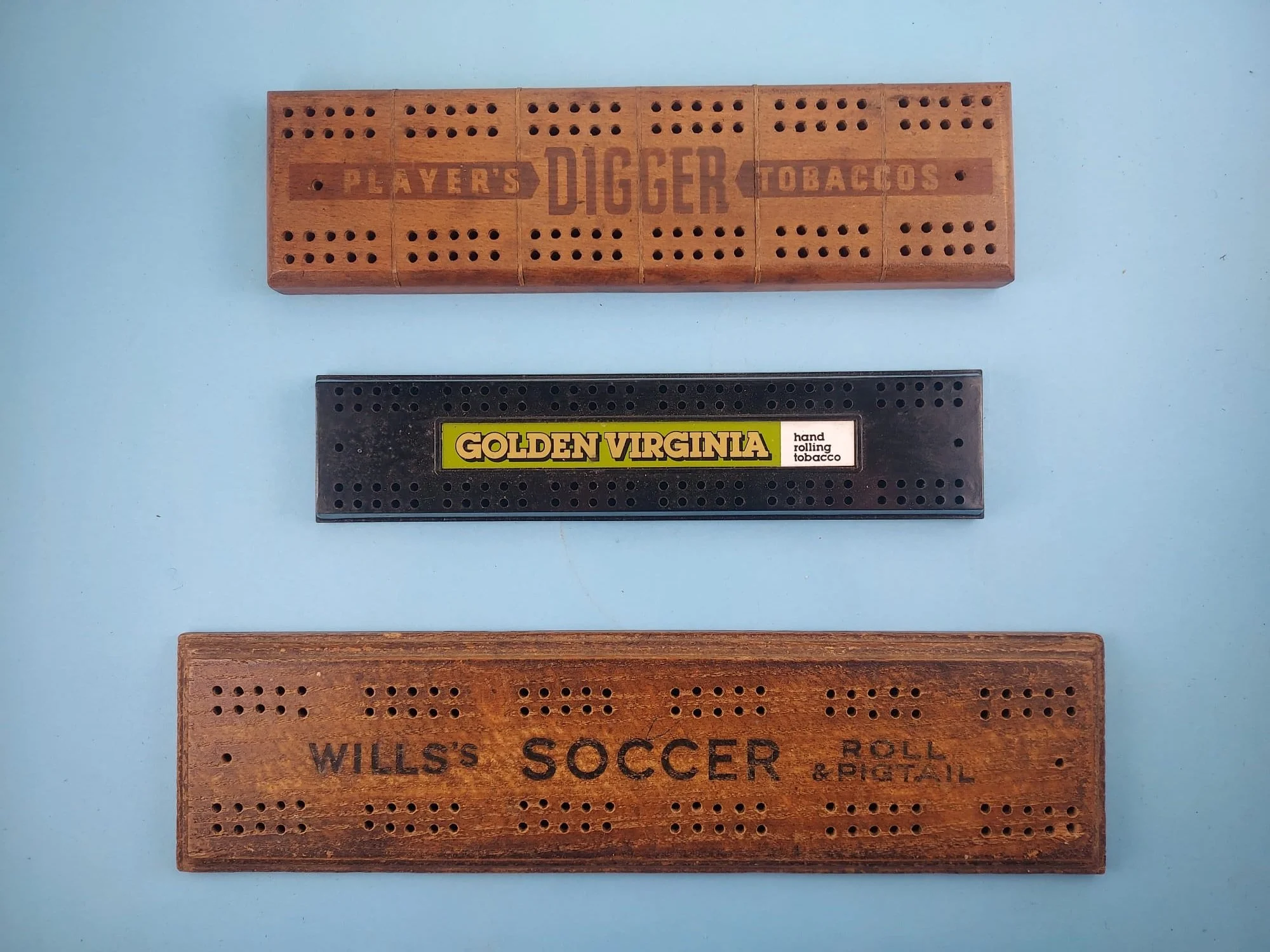
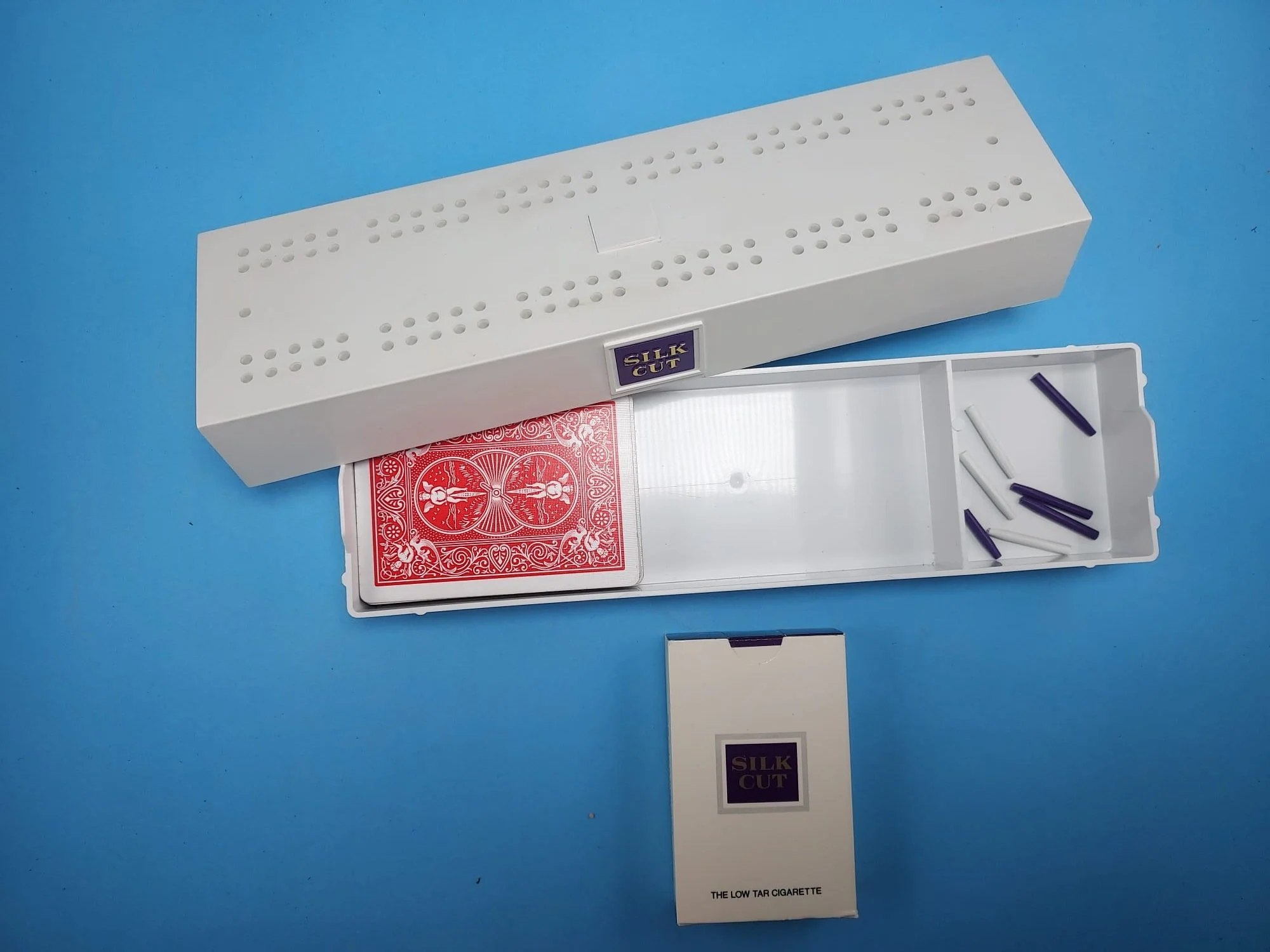
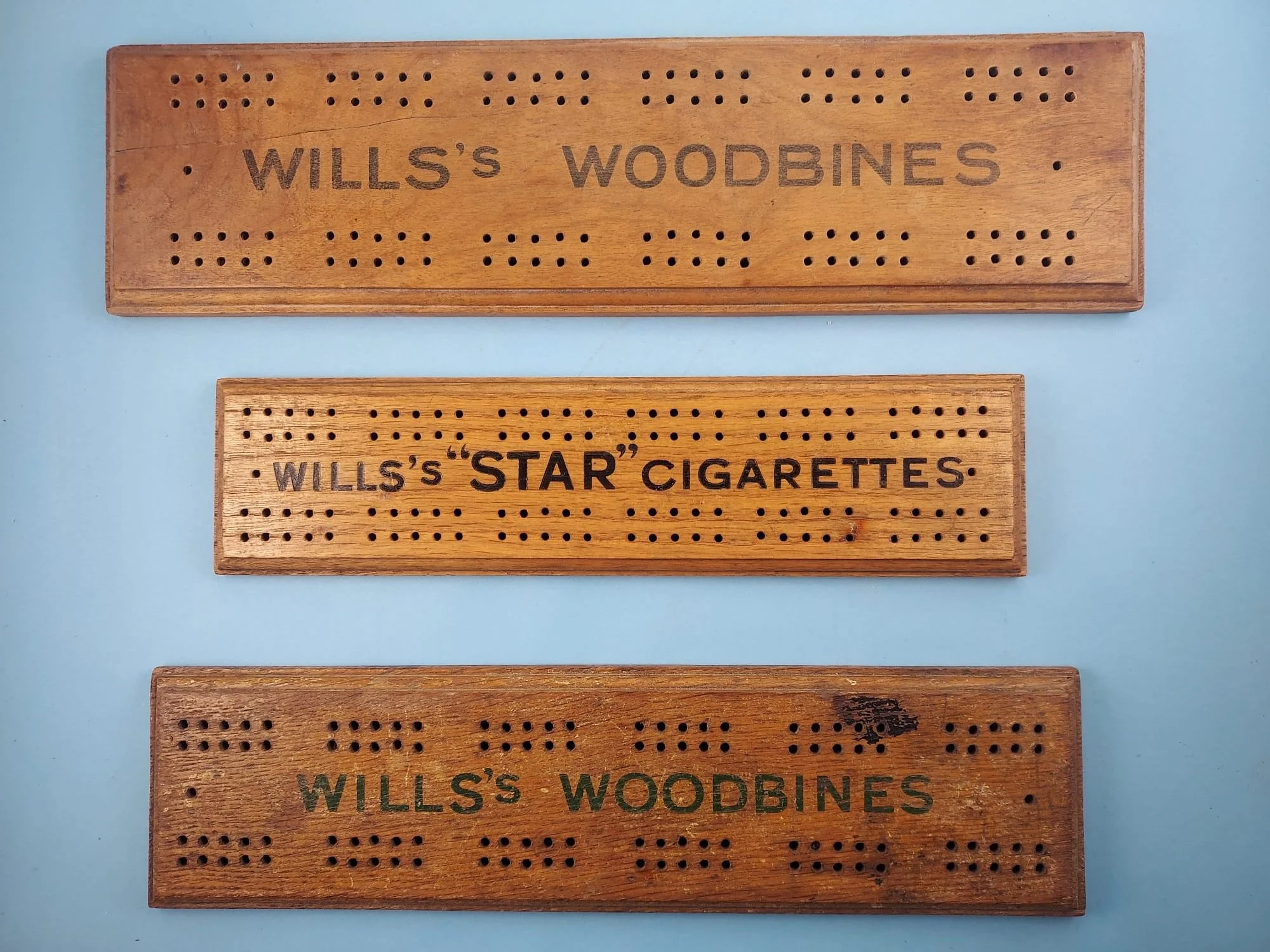
The game of cribbage has been around for several hundred years, and to play it a board is used for scoring. (A dominoes – or ‘threes and fives’ – board is, as far as I know, interchangeable.) Richard and Dickie, when they’re not working their socks off at the archive, often play cribbage, and have taken to collecting those old boards which have advertising. They have a dozen or so now, and from that sample it’s clear that tobacco and alcohol companies were quick to use cribbage boards for subliminal advertising.
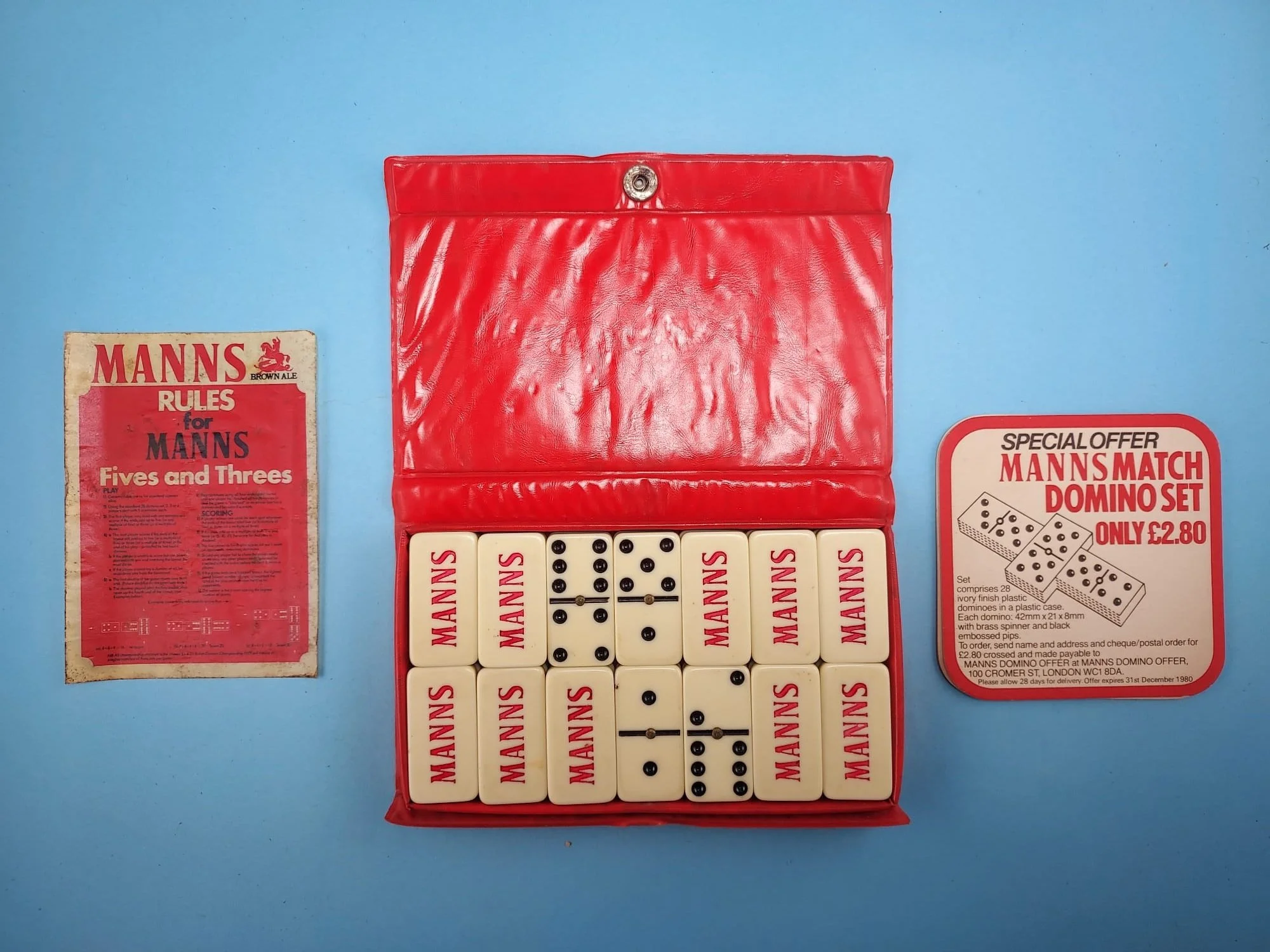
Boards (embossed with advertising) were supplied to pubs, and cribbage sets and boards made available, probably for free, to play over your pint. We know that cribbage – or, certainly, dominoes – was played routinely in pubs into the 1980s, but probably not for much longer. We know it was a thing until this time because we have in our collection three beer mats which coincide with the Mann’s and Sunday People’s National Domino Championships for 1978 (when it was first held), 1980 and 1981, and these offer domino sets for sale. We also have a set of Mann’s ‘Fives and Threes’ dated 1979, shown here.
Taking a closer look at what is being advertised, Will’s promote their Star and Woodbine cigarettes, plus Soccer tobacco, while Player’s advertise their Digger tobacco. The boards are all wood, although Golden Virginia tobacco’s is, we think, bakelite. Silk Cut provide a set of playing cards with their cribbage set. Digger (the name for an Australian soldier) was a pipe tobacco introduced around the time of the First World War, and a product of the then British empire.
Will’s introduced their Woodbine cigarettes in 1888, and their Star cigarettes in 1893, when mass production enabled cigarette-smoking to trickle down the social scale. I’m not sure when their Soccer rolling tobacco was introduced, but let’s say between the wars.
We can date some of our boards too. The plastic Silk Cut set is probably 1980s, but the wooden boards are much older, and here we can use the ITC number stamped on the back of some of them. Of these, the Digger board has an ITC number which corresponds with 1936. Physically, the biggest boards are for Will’s Woodbine, one c1925, the other 1934, while our Star board is 1934. It’s clear that the boards became less ornate, that is, cheaper to make, with the passing of the years, as the remainder of the boards, being newer, mostly post-war, are much plainer.
The advertising of cigarettes on the television was banned in 1965, but I’m less clear in my mind about how further legislation may have applied to paraphernalia such as cribbage boards.